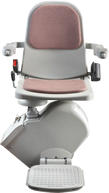


Stairlift Glossary of Terms
Our Stairlifts are specifically designed to be a safer solution to using your stairs, this page aims to define those stairlift terms.
DC (battery) power
All our Stairlifts, including our straight stairlift and curved stairlift, are DC battery powered which means that they are power efficient and you’ll still be able to use your stairlift even in a power cut!
There are many advantages of having a DC powered stairlift and they include:
- No messy trailing cables that could cause you to trip and fall over
- In a power cut your stairlift keeps on working for up to 20 journeys
- The stairlift is power efficient, only charging when needed and not constantly using power
The history of battery powered stairlifts
DC technology was chosen due to the inherent advantages of safety, smooth power delivery and the ability to operate normally during a mains power failure.
Diagnostic digital display
The Curved Stairlift and the Straight Stairlift are fitted with a digital diagnostic display which states the current status of the stairlift.
Faults are rare and are displayed digitally as numbers and/or letters, providing clear and simple information for users and engineers. When calling customer support, be sure to make note of what code the display shows.
Dual electronic and mechanical braking systems
Fitted as standard on the stairlift are double safety braking systems mean that the stairlift is unable to descend unexpectedly or at speed. This is an essential safety feature that is imperitive to have on your stairlift.
Fold-up seat & footrest
All our Stairlifts have a fold-up seat, arm rests & footrest. When not in use, the seat, arms and footrest of the stairlift can be folded away to provide easy access to the stairway.
Heavy Duty
Specifically designed individuals who may be of a larger build, our maximum weight capacity on either the outdoor, perch or straight stairlift is 350lbs or 25 stone.
Infra-red remote control
The stairlift can be ‘called’ or ‘sent’ up or down the stairs by using a remote control similar to a TV remote control.
Lockable isolation switch
The stairlift can be locked with a key so that others (children, for example) cannot use it. The stairlift continues to charge when locked.
Overhang
If the stairlift overhangs at the top of the stairs there will be an extra piece of track that protrudes onto the landing.
Overspeed governor
Controls the speed of the stairlift to prevent sudden or rapid descent.
‘Paddle’ switch control
The up and down motion of the stairlift is operated by a simple paddle switch on both arms of the chair. The paddle switch controls come as standard with our straight stairlift and curved stairlifts.
Rack and pinion drive
The stairlift track uses this secure drive mechanism to provide smooth and stable movement up and down the stairs.
Safety cut-out sensors
Special safety sensors in the stairlift footrest and carriage prevent it from moving if an object is obstructing the path of the stairlift.
Smooth start/stop action
The stairlift’s upward and downward movement begins smoothly and slowly, without jarring or sudden stops. This enables you to have a smooth ride up and down your stairs.
Stand or Perch
Perch Stairlift
Designed for users who have trouble bending at the knee, the Perch Stairlift still allows the user to travel in safety and comfort.
- Suitable for those with knee troubles
- Suitable for narrow staircases
- Safe, comfortable and easy to use
Sit / Stand Stairlift
Designed for multiple users with different requirements, the Sit/Stand Stairlift allows the user to either sit or stand.
- Sit or stand – it’s your choice
- Suitable for narrow staircases
- Safe, comfortable and easy to use
Swivel seat with locking catch
The seat of the stairlift turns for ease of access at the top of the stairs, and locks to prevent accidental slipping.
Weight Capacity
This refers to the maximum weight a particular stairlift will carry.